Hip Pain Treatment in Indore – When Everyday Movements Start Becoming Difficult
Many people assume hip arthritis only affects very elderly individuals.
However, patients often begin experiencing symptoms years before they realize their hip joint is the real problem.
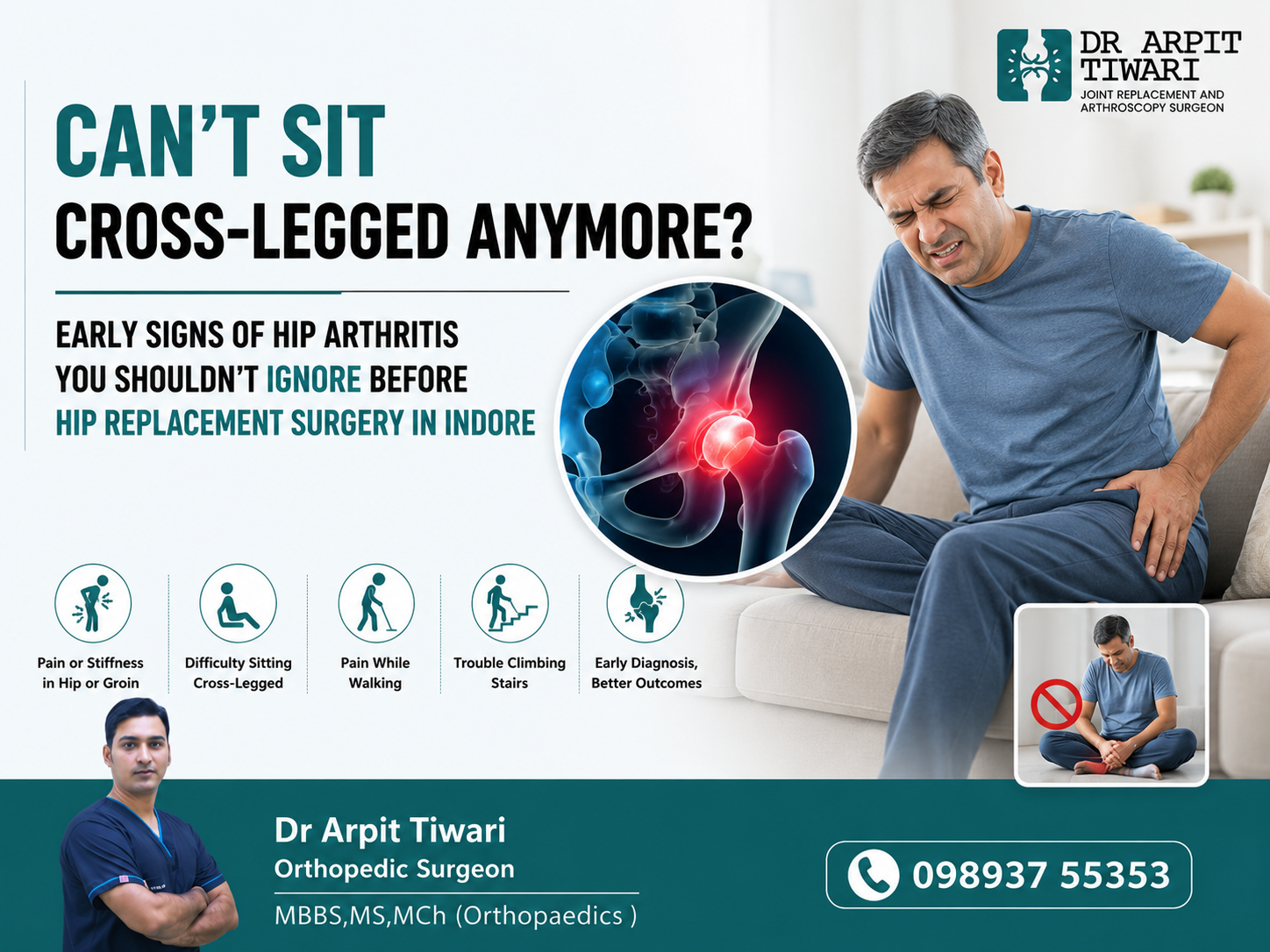
One of the earliest complaints orthopedic specialists hear is surprisingly simple:
“Doctor, I can no longer sit cross-legged comfortably.”
Others notice:
• Difficulty getting up from the floor
• Pain while wearing shoes
• Trouble climbing stairs
• Stiffness after sitting
• Difficulty getting out of a car
• Limping while walking
Most people blame age, weight gain, or muscle weakness.
Unfortunately, these symptoms may actually indicate the beginning of Hip Arthritis, a progressive condition that can eventually require Hip Replacement Surgery in Indore if left untreated.
At Jyoti Hospital, Vijay Nagar, Indore, Dr. Arpit Tiwari, Joint Replacement and Trauma Surgeon with over 15 years of experience and 15,000+ successful surgeries, helps patients identify hip arthritis early before significant joint damage affects mobility and quality of life.
Hip Arthritis Treatment in Indore – Why Sitting Cross-Legged Becomes Difficult
The hip joint is one of the largest weight-bearing joints in the body.
It allows:
• Walking
• Sitting
• Bending
• Climbing stairs
• Squatting
• Sitting cross-legged
A healthy hip joint moves smoothly because it is covered by protective cartilage.
When arthritis develops:
• Cartilage gradually wears away
• Joint surfaces become rough
• Inflammation increases
• Movement becomes painful
• Stiffness develops
As a result, movements requiring flexibility become increasingly difficult.
Sitting cross-legged is often one of the first activities affected.
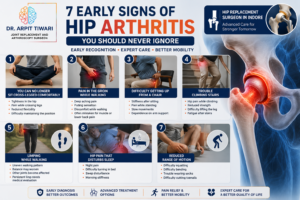
Hip Replacement Surgeon in Indore – 7 Early Signs of Hip Arthritis You Should Never Ignore
Sign #1: You Can No Longer Sit Cross-Legged Comfortably
This is one of the most overlooked symptoms.
Patients who previously sat comfortably on the floor begin noticing:
• Tightness in the hip
• Pain while crossing legs
• Reduced flexibility
• Difficulty maintaining the position
Many ignore these symptoms for years.
Sign #2: Pain in the Groin While Walking
Unlike knee arthritis, hip arthritis frequently causes pain in the groin area.
Patients often describe:
• Deep aching pain
• Pulling sensation
• Discomfort while walking
Many mistakenly believe the problem is related to muscles or the lower back.
According to Dr. Arpit Tiwari, groin pain is one of the most important indicators of hip joint pathology.
Sign #3: Difficulty Getting Up from a Chair
A healthy hip joint should allow smooth standing movements.
When arthritis develops, patients often experience:
• Stiffness after sitting
• Pain while standing
• Slow movements
• Dependence on arm support
This symptom often worsens gradually.
Sign #4: Trouble Climbing Stairs
Stair climbing places significant stress on the hip joint.
Patients may notice:
• Hip pain while climbing
• Reduced strength
• Difficulty lifting the leg
• Fatigue after stairs
This frequently indicates progression of arthritis.
Sign #5: Limping While Walking
A limp is never normal.
Many patients unconsciously change the way they walk to avoid pain.
Over time:
• Walking becomes uneven
• Balance may worsen
• Other joints become affected
A persistent limp deserves evaluation by a Hip Specialist in Indore.
Sign #6: Hip Pain That Disturbs Sleep
Early arthritis may only hurt during activity.
Advanced arthritis often causes:
• Night pain
• Difficulty turning in bed
• Sleep disturbance
• Morning stiffness
This usually indicates worsening joint damage.
Sign #7: Reduced Range of Motion
Many patients notice:
• Difficulty squatting
• Difficulty bending
• Trouble wearing socks
• Difficulty cutting toenails
These symptoms often develop gradually and are easy to overlook.
Hip Specialist in Indore – Why Hip Arthritis Is Often Misdiagnosed
One reason patients delay treatment is because hip arthritis symptoms can resemble other conditions.
Back Pain
Pain may radiate into the thigh.
Muscle Strain
Early symptoms often feel muscular.
Sciatica
Hip pain can sometimes mimic nerve-related symptoms.
Knee Pain
Many patients feel pain in the knee even when the hip is the actual source.
This is why a detailed orthopedic evaluation is important.
Dr. Arpit Tiwari Explains What Happens If Hip Arthritis Is Ignored
Hip arthritis usually worsens over time.
Without treatment:
• Cartilage continues deteriorating
• Pain increases
• Mobility decreases
• Walking becomes difficult
• Muscle weakness develops
• Independence may be affected
Many patients eventually reach a stage where daily activities become extremely challenging.
Early intervention often helps delay progression.
Hip Pain Treatment in Indore – Do All Patients Need Hip Replacement Surgery?
Absolutely not.
Many patients improve with:
Weight Management
Reducing stress on the hip joint.
Physiotherapy
Strengthening surrounding muscles.
Activity Modification
Protecting the joint from excessive strain.
Medication
Managing pain and inflammation.
Lifestyle Changes
Improving overall joint health.
The key is identifying the condition before severe damage occurs.
When Does Hip Replacement Surgery Become Necessary?
According to Dr. Arpit Tiwari, Hip Replacement Surgery may be considered when:
Pain Becomes Constant
Symptoms affect daily life.
Walking Distance Reduces Significantly
Patients struggle with routine activities.
Sleep Is Frequently Disturbed
Night pain becomes common.
Conservative Treatments Fail
Pain persists despite medication and therapy.
X-Rays Show Advanced Arthritis
Significant cartilage loss and joint damage are present.
At this stage, surgery may provide substantial improvement in mobility and quality of life.
Hip Replacement Surgery in Indore – Modern Recovery Is Different Than Most People Think
Many patients fear hip replacement because they imagine:
• Months of bed rest
• Severe postoperative pain
• Long hospital stays
Modern surgical techniques have significantly improved recovery.
Most patients are encouraged to begin movement under supervision and gradually regain independence through structured rehabilitation.
Why Patients Choose Dr. Arpit Tiwari for Hip Replacement Surgery in Indore
15+ Years of Experience
Extensive expertise in orthopedic and joint replacement surgery.
15,000+ Successful Surgeries
Trusted by patients across Madhya Pradesh.
Advanced Joint Replacement Expertise
Specialized treatment for hip and knee arthritis.
Personalized Treatment Planning
Every patient receives an individualized approach.
Comprehensive Orthopedic Care
Diagnosis, surgery, rehabilitation, and follow-up under one roof.
Trusted Orthopedic Surgeon in Vijay Nagar, Indore
Helping patients regain mobility and independence.
Frequently Asked Questions
Is difficulty sitting cross-legged always caused by hip arthritis?
No. However, it is one of the common early symptoms that deserves evaluation.
Can hip arthritis cause groin pain?
Yes. Groin pain is one of the most characteristic symptoms of hip arthritis.
At what age does hip arthritis occur?
Although more common in older adults, it can occur earlier depending on injury, genetics, and lifestyle factors.
Can physiotherapy cure hip arthritis?
Physiotherapy can help manage symptoms but cannot reverse cartilage loss.
How do I know if I need hip replacement surgery?
A complete evaluation by a Joint Replacement Specialist is necessary.
Can hip arthritis be treated without surgery?
Many early-stage cases respond well to non-surgical management.
Hip Arthritis Treatment in Indore – Conclusion
If you can no longer sit cross-legged comfortably, struggle to get up from a chair, experience groin pain while walking, or notice increasing stiffness in your hip, these symptoms should not be dismissed as normal ageing.
They may be early warning signs of hip arthritis.
Seeking treatment early can help preserve mobility, reduce pain, and potentially delay the need for surgery.
At Jyoti Hospital, Vijay Nagar, Indore, Dr. Arpit Tiwari, Joint Replacement and Trauma Surgeon with 15+ years of experience and 15,000+ successful surgeries, provides comprehensive evaluation and advanced treatment for hip arthritis, helping patients return to a more active and comfortable life before joint damage becomes severe.