
Joint replacement surgery can significantly improve the quality of life for people suffering from severe knee or hip pain caused by arthritis, injury, or joint degeneration. However, the surgery itself is only the first step toward recovery. A structured rehabilitation program plays an equally important role in helping patients regain strength, flexibility, balance, and confidence. Understanding Physiotherapy After Joint Replacement: Recovery Timeline & Benefits helps patients know what to expect during recovery and how physiotherapy contributes to long-term success after surgery.
Whether you have undergone a knee replacement or hip replacement, physiotherapy helps reduce stiffness, improve joint movement, strengthen surrounding muscles, and restore normal walking. Recovery is a gradual process, and following the recommended rehabilitation plan can significantly improve mobility while reducing the risk of complications.
At Jyoti Hospital, Indore, Dr. Arpit Tiwari, one of the leading Joint Replacement and Trauma Surgeons, provides comprehensive joint replacement care along with personalized rehabilitation guidance. With more than 15 years of experience and over 15,000 successful orthopedic surgeries, he helps patients achieve faster recovery through advanced surgical techniques and evidence-based physiotherapy protocols.
Best Joint Replacement Surgeon in Indore – Dr. Arpit Tiwari
Recovering successfully after joint replacement requires expert surgery, proper rehabilitation, and continuous medical guidance. Dr. Arpit Tiwari specializes in advanced joint replacement procedures designed to relieve pain, improve mobility, and restore an active lifestyle.
He provides comprehensive orthopedic care for:
✔ Total Knee Replacement
✔ Total Hip Replacement
✔ Revision Joint Replacement Surgery
✔ Arthritis Treatment
✔ Sports Injury Management
✔ Trauma & Fracture Surgery
✔ Shoulder Disorders
✔ Hip Pain Treatment
✔ Knee Pain Treatment
✔ Joint Preservation Procedures
✔ Reconstructive Orthopedic Surgery
✔ Post-Joint Replacement Rehabilitation
Every treatment plan is customized according to the patient’s age, lifestyle, medical condition, and recovery goals.
About Dr. Arpit Tiwari
Dr. Arpit Tiwari is widely recognized as one of the Best Joint Replacement Surgeons in Indore with extensive experience in knee replacement, hip replacement, trauma surgery, and advanced orthopedic care. His commitment to clinical excellence and patient-centered treatment has helped thousands of patients return to pain-free and active lives.
With more than 15 years of experience and over 15,000 successful orthopedic surgeries, Dr. Tiwari combines advanced surgical expertise with personalized rehabilitation to ensure the best possible outcomes.
His educational and professional achievements include:
✔ MCh in Orthopaedics & Reconstructive Surgery – Ninewells Hospital, University of Dundee, Scotland (UK)
✔ Joint Replacement Fellowship – Nanavati Super Speciality Hospital, Mumbai
✔ Stryker Fellowship – Primus Super Speciality Hospital, New Delhi
✔ MS in Orthopaedics – Aurobindo Institute of Medical Sciences, Indore
He has also participated in several national and international training programs in knee and hip arthroplasty, computer-navigated joint replacement, trauma management, and minimally invasive orthopedic surgery.
Why Choose Dr. Arpit Tiwari?
Choosing an experienced orthopedic surgeon plays an important role in achieving excellent long-term results after joint replacement surgery.
Patients choose Dr. Arpit Tiwari because of:
✔ More than 15 years of orthopedic experience
✔ 15,000+ successful orthopedic surgeries
✔ Expertise in Knee Replacement Surgery
✔ Expertise in Hip Replacement Surgery
✔ Advanced Joint Replacement Techniques
✔ International Orthopedic Training
✔ Personalized Rehabilitation Guidance
✔ Minimally Invasive Surgical Techniques
✔ Comprehensive Trauma Care
✔ Patient-Centered Treatment
✔ Focus on Faster Recovery and Improved Mobility
His goal is to help every patient regain independence, reduce pain, and enjoy a healthier, more active lifestyle.
What Is Physiotherapy After Joint Replacement?
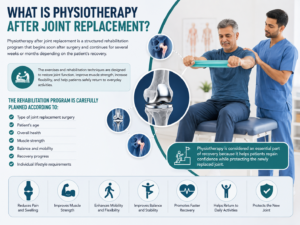
Physiotherapy after joint replacement is a structured rehabilitation program that begins soon after surgery and continues for several weeks or months depending on the patient’s recovery. The exercises and rehabilitation techniques are designed to restore joint function, improve muscle strength, increase flexibility, and help patients safely return to everyday activities.
The rehabilitation program is carefully planned according to:
✔ Type of joint replacement surgery
✔ Patient’s age
✔ Overall health
✔ Muscle strength
✔ Balance and mobility
✔ Recovery progress
✔ Individual lifestyle requirements
Physiotherapy is considered an essential part of recovery because it helps patients regain confidence while protecting the newly replaced joint.
Why Is Physiotherapy Important After Joint Replacement?
Joint replacement surgery relieves damaged joint surfaces, but surrounding muscles and soft tissues require rehabilitation to function normally again. Physiotherapy helps the body adapt to the new joint while preventing stiffness and improving movement.
Benefits of early physiotherapy include:
✔ Improves joint flexibility
✔ Restores muscle strength
✔ Reduces pain and stiffness
✔ Improves blood circulation
✔ Reduces swelling
✔ Helps restore normal walking
✔ Improves balance
✔ Reduces the risk of blood clots
✔ Supports faster recovery
✔ Improves long-term joint function
Patients who follow a structured rehabilitation program often recover faster and achieve better long-term mobility.
Recovery Timeline After Joint Replacement
Recovery varies from person to person depending on age, general health, the type of surgery performed, and commitment to physiotherapy.
First 24–48 Hours After Surgery
Rehabilitation usually begins within the first day after surgery under medical supervision.
Early goals include:
✔ Gentle ankle exercises
✔ Breathing exercises
✔ Sitting with support
✔ Standing with assistance
✔ Walking short distances using a walker
✔ Pain management
✔ Swelling control
Early movement helps improve circulation and reduces the risk of complications after surgery.
Week 1 After Surgery
During the first week, patients gradually become more comfortable walking and performing basic daily activities.
The rehabilitation program may include:
✔ Walking with a walker
✔ Knee bending exercises (for knee replacement)
✔ Hip strengthening exercises (for hip replacement)
✔ Muscle activation exercises
✔ Gentle range-of-motion exercises
✔ Bed mobility training
✔ Stair practice (when appropriate)
The focus during this stage is on reducing pain, improving confidence, and safely increasing mobility.
Week 2–6 After Joint Replacement
As healing progresses, physiotherapy becomes more focused on improving muscle strength, joint flexibility, and walking without assistance. During this phase, many patients gradually return to routine daily activities under the guidance of their orthopedic surgeon and physiotherapist.
The rehabilitation program may include:
✔ Increased walking distance
✔ Strengthening exercises
✔ Balance training
✔ Stair climbing practice
✔ Chair sitting and standing exercises
✔ Stationary cycling (when recommended)
✔ Improved range-of-motion exercises
✔ Functional movement training
Patients are encouraged to continue their exercises regularly to achieve the best possible recovery.
Recovery After 6–12 Weeks
By this stage, most patients experience significant improvement in pain and mobility. Walking becomes easier, and many individuals resume light household work and low-impact activities.
Recovery goals during this stage include:
✔ Walking without support (when advised)
✔ Improved joint flexibility
✔ Better muscle strength
✔ Increased endurance
✔ Improved balance
✔ Return to daily activities
✔ Better coordination
✔ Increased confidence while walking
Although recovery improves considerably, continuing physiotherapy remains important for achieving long-term joint function.
Long-Term Recovery (3–12 Months)
Complete recovery after joint replacement varies from patient to patient. Most individuals continue gaining strength and flexibility for several months after surgery.
Long-term rehabilitation focuses on:
✔ Improving overall fitness
✔ Maintaining joint mobility
✔ Strengthening muscles around the joint
✔ Improving posture
✔ Preventing falls
✔ Maintaining a healthy weight
✔ Returning to recreational activities
✔ Long-term joint protection
Following the rehabilitation plan helps maximize the lifespan and function of the replaced joint.
Benefits of Physiotherapy After Joint Replacement
Physiotherapy is one of the most important factors influencing successful recovery after knee or hip replacement surgery. Regular rehabilitation helps patients regain independence while reducing the risk of complications.
Major benefits include:
✔ Faster recovery
✔ Better joint movement
✔ Reduced stiffness
✔ Less postoperative pain
✔ Improved muscle strength
✔ Better balance and coordination
✔ Improved walking pattern
✔ Reduced swelling
✔ Lower risk of blood clots
✔ Increased joint stability
✔ Improved confidence
✔ Better quality of life
Patients who actively participate in physiotherapy generally recover more quickly and achieve better long-term outcomes.
Physiotherapy Exercises After Joint Replacement
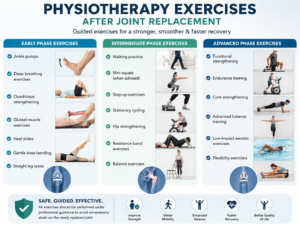
Exercise programs are carefully designed according to the stage of recovery and individual patient needs.
Common rehabilitation exercises include:
Early Phase Exercises
✔ Ankle pumps
✔ Deep breathing exercises
✔ Quadriceps strengthening
✔ Gluteal muscle exercises
✔ Heel slides
✔ Gentle knee bending
✔ Straight leg raises
Intermediate Phase Exercises
✔ Walking practice
✔ Mini squats (when advised)
✔ Step-up exercises
✔ Stationary cycling
✔ Hip strengthening
✔ Resistance band exercises
✔ Balance exercises
Advanced Phase Exercises
✔ Functional strengthening
✔ Endurance training
✔ Core strengthening
✔ Advanced balance training
✔ Low-impact aerobic exercises
✔ Flexibility exercises
All exercises should be performed under professional guidance to avoid unnecessary strain on the newly replaced joint.
Precautions After Joint Replacement Surgery
Following your surgeon’s advice is essential for a safe recovery and protecting the new joint.
Patients are generally advised to:
✔ Avoid high-impact activities
✔ Do not lift heavy weights during early recovery
✔ Follow prescribed physiotherapy exercises
✔ Take medications as instructed
✔ Keep the surgical wound clean
✔ Attend regular follow-up appointments
✔ Maintain a healthy body weight
✔ Use walking aids until advised otherwise
✔ Avoid sudden twisting movements
✔ Wear supportive footwear
These precautions help reduce complications and support smooth healing.
When Should You Contact Your Orthopedic Surgeon?
Although most patients recover without major problems, certain symptoms require immediate medical attention.
Consult your orthopedic surgeon if you experience:
✔ Severe or increasing pain
✔ Persistent swelling
✔ Fever after surgery
✔ Redness around the surgical wound
✔ Wound discharge
✔ Difficulty walking that suddenly worsens
✔ Sudden calf pain or swelling
✔ Shortness of breath
✔ New numbness or weakness
✔ Limited joint movement despite rehabilitation
Prompt evaluation allows early management of potential complications and protects the long-term success of joint replacement surgery.
Why Choose Dr. Arpit Tiwari for Joint Replacement Surgery?
Successful joint replacement depends not only on surgical expertise but also on proper rehabilitation planning and long-term follow-up. Dr. Arpit Tiwari combines advanced orthopedic techniques with comprehensive recovery guidance to help patients regain mobility safely and confidently.
Patients choose Dr. Arpit Tiwari because of:
✔ 15+ Years of Orthopedic Experience
✔ 15,000+ Successful Orthopedic Surgeries
✔ Expertise in Knee & Hip Replacement
✔ International Fellowships in Joint Replacement
✔ Advanced Minimally Invasive Techniques
✔ Personalized Rehabilitation Programs
✔ Comprehensive Trauma & Orthopedic Care
✔ Patient-Centered Treatment Approach
✔ Faster Recovery Protocols
✔ Advanced Surgical Planning
✔ Treatment at Jyoti Hospital, Indore
His focus is on helping every patient achieve pain relief, improved mobility, and a successful return to an active lifestyle through expert surgical care and structured rehabilitation.
Currently Serving Patients Across Indore
Dr. Arpit Tiwari provides advanced orthopedic care for patients across Indore and nearby regions at Jyoti Hospital, Vijay Nagar. With expertise in joint replacement, trauma surgery, and reconstructive orthopedic procedures, he helps patients regain pain-free movement and improve their quality of life through advanced surgical techniques and personalized rehabilitation.
He provides specialized treatment for:
✔ Total Knee Replacement
✔ Total Hip Replacement
✔ Revision Knee Replacement
✔ Revision Hip Replacement
✔ Arthritis Treatment
✔ Knee Pain
✔ Hip Pain
✔ Sports Injuries
✔ Ligament Injuries
✔ Fracture & Trauma Surgery
✔ Shoulder Disorders
✔ Joint Deformities
✔ Post-Joint Replacement Rehabilitation
✔ Physiotherapy After Joint Replacement
✔ Orthopedic Consultation
Patients from Vijay Nagar, Palasia, Rau, Dewas Naka, Bengali Square, MR-10, MR-11, Bypass Road, and nearby regions trust Dr. Arpit Tiwari for comprehensive orthopedic care and successful joint replacement outcomes.
Tips for Faster Recovery After Joint Replacement
Recovering successfully after joint replacement requires dedication to rehabilitation and healthy lifestyle habits. Following your orthopedic surgeon’s instructions can help speed up healing and improve long-term joint function.
Helpful recovery tips include:
✔ Perform physiotherapy exercises regularly
✔ Walk daily as advised
✔ Take medications on time
✔ Maintain a healthy body weight
✔ Eat a balanced diet rich in protein and calcium
✔ Stay well hydrated
✔ Avoid prolonged sitting
✔ Use walking aids until advised otherwise
✔ Keep follow-up appointments
✔ Wear supportive footwear
✔ Avoid high-impact activities
✔ Report unusual symptoms immediately
Consistent rehabilitation and regular follow-up play a vital role in achieving the best possible outcome after joint replacement surgery.
Common Myths About Physiotherapy After Joint Replacement
Many patients hesitate to begin physiotherapy because of common misconceptions. Understanding the facts helps patients recover safely and confidently.
Myth 1: Complete Bed Rest Helps You Recover Faster
Fact: Early movement under medical supervision improves blood circulation, prevents stiffness, reduces complications, and supports faster recovery.
Myth 2: Physiotherapy Is Too Painful to Continue
Fact: Mild discomfort during exercise is normal, but physiotherapy is carefully planned according to each patient’s recovery stage. It helps reduce pain over time rather than increase it.
Myth 3: Once Pain Improves, Physiotherapy Is No Longer Needed
Fact: Pain relief does not mean recovery is complete. Continuing physiotherapy strengthens muscles, improves joint function, and reduces the risk of future complications.
Myth 4: Joint Replacement Means You Cannot Walk Normally Again
Fact: With successful surgery and proper rehabilitation, many patients return to walking independently and enjoy an active lifestyle.
Myth 5: Physiotherapy Is Only Important for Knee Replacement
Fact: Rehabilitation is equally important after both knee replacement and hip replacement surgeries to restore strength, flexibility, and normal movement.
Summary
Physiotherapy After Joint Replacement is an essential part of recovery following knee or hip replacement surgery. While the surgical procedure relieves pain caused by damaged joints, structured rehabilitation helps restore strength, flexibility, balance, and normal walking. Beginning physiotherapy early and following a personalized recovery plan can reduce stiffness, improve mobility, prevent complications, and support long-term joint function.
At Jyoti Hospital, Indore, Dr. Arpit Tiwari provides comprehensive joint replacement care along with personalized rehabilitation guidance. With more than 15 years of experience, over 15,000 successful orthopedic surgeries, and advanced international training in joint replacement, he helps patients achieve faster recovery and return to an active, pain-free lifestyle through expert surgical care and evidence-based rehabilitation.
FAQs – Physiotherapy After Joint Replacement: Recovery Timeline & Benefits
1. When should physiotherapy begin after joint replacement surgery?
Physiotherapy usually begins within 24 to 48 hours after surgery, depending on the patient’s condition and the surgeon’s recommendation.
2. How long does physiotherapy continue after knee or hip replacement?
Most patients continue physiotherapy for 6 to 12 weeks, although some individuals may benefit from rehabilitation for several months depending on their recovery progress.
3. Is physiotherapy necessary after joint replacement?
Yes. Physiotherapy is essential for improving joint movement, strengthening muscles, reducing stiffness, restoring mobility, and achieving the best long-term outcome after surgery.
4. Can I walk immediately after joint replacement surgery?
Many patients begin walking with the help of a walker or other assistive device within one or two days after surgery under professional supervision.
5. When can I return to normal daily activities?
Most patients gradually return to routine activities within 6 to 12 weeks, although complete recovery may continue for several months.
6. What activities should be avoided after joint replacement?
Patients should avoid high-impact sports, heavy lifting, sudden twisting movements, and activities not approved by their orthopedic surgeon during the recovery period.
7. Does physiotherapy reduce pain after joint replacement?
Yes. A structured rehabilitation program helps reduce pain, improve flexibility, strengthen muscles, and restore normal joint function.
8. Who should I consult for Joint Replacement Surgery and Rehabilitation in Indore?
Dr. Arpit Tiwari, an experienced Joint Replacement and Trauma Surgeon at Jyoti Hospital, Indore, provides comprehensive joint replacement surgery and personalized physiotherapy guidance for successful recovery.
Conclusion – Physiotherapy After Joint Replacement: Recovery Timeline & Benefits
Recovering from knee or hip replacement surgery is a gradual journey that extends beyond the operating room. Physiotherapy After Joint Replacement plays a vital role in restoring mobility, strengthening muscles, improving balance, and helping patients safely return to their daily activities. Following a structured rehabilitation program and maintaining regular follow-up with an experienced orthopedic surgeon significantly improves long-term outcomes and the overall success of joint replacement surgery.
At Jyoti Hospital, Indore, Dr. Arpit Tiwari combines advanced joint replacement techniques with personalized rehabilitation plans to help patients achieve a faster, safer, and more comfortable recovery. With extensive experience, international training, and a patient-centered approach, he is committed to helping every patient regain confidence, independence, and a pain-free, active lifestyle.